
Attraction, Boundaries and Choice
That feeling
As we grow older, we start experiencing new feelings, sometimes without any warning. Just like a magnet is drawn to iron, we can find ourselves drawn to another person.
You may find yourself thinking about someone a lot. You might want to be near them, talk to them, or just notice when they walk into a room. This is called having a crush, and it is completely normal.
You may have these feelings for a person of a different gender, or someone of the same gender as you. Attraction does not follow a single fixed path.
AARAV’S STORY

Aarav, 15
“I finally told Rhea how I felt. I was so nervous I almost fumbled over my words. But she was kind about it. She said we should spend more time together first, to get to know each other better. I feel relieved. And a little happy too.”

“Why is my body acting before my brain does?”
Attraction can show up in your body before you have even had a chance to think. A racing heart, warm cheeks, sweaty palms, or a strange alertness when someone you like walks in, these are all automatic reactions.
You are not doing this on purpose. Your nervous system is responding to something it perceives as significant. This is biology, not a decision.
IRA’S STORY

Ira, 14
“During assembly, the person I liked stood next to me and suddenly my heart was racing. My face felt warm. I kept wondering am I making this happen? Am I doing something weird?”
She wasn’t. Her body was reacting before she had time to think. That is how attraction sometimes works.

What does attraction actually look like?
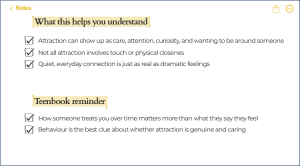
Attraction does not always look dramatic. It does not always involve touch, grand gestures, or the kind of stories you see in films or TV series. In real life, it often looks much quieter.
SANA’S STORY

Sana, 15
“For me, it showed up as wanting to sit next to them in class. Talking longer than I needed to. Sharing a playlist. Checking if they were okay after a hard day. There was no physical closeness but the connection felt very real.”
The s-word : Let’s talk about it
Sex. There, we said it. It is a word that often makes people go quiet, or giggle, or change the subject. But it is also a word that raises a lot of honest questions and honest questions deserve honest answers.
A COMMON MOMENT

“I heard the word on TV. I immediately felt a little embarrassed, even though I was alone. Why do I feel like it is something I am not supposed to know about?”
What it actually is
Sex, or sexual intercourse, is a physical way of expressing attraction between two people who both want to be close to each other in that way. Like hugging or cuddling, it is a form of closeness but one that requires much more preparation, maturity, and clear agreement from both people.
It is possible for a male and a female to conceive a baby through sexual intercourse after puberty, but most people who have sex are not trying to have a baby. They may simply want to feel close to someone they care about.
There are many other ways to express attraction that are just as meaningful: caring for someone, listening, respecting them, sharing things you love, being there when things are hard.

“I feel something. Do I have to act on it?”
When you feel attracted to someone, there is often pressure from friends, stories or films to do something about it right away. Confess. Ask them out. Make it official.
But feeling attracted to someone does not come with a deadline. There is no rule that says you must act.
AMAN’S STORY

Aman, 14
“When I realised I liked someone in my class, my friends immediately started asking: when will you tell them? When will you ask them out? But I liked things as they were. Talking in class. Sharing notes. Smiling when we passed each other. I realised I do not have to do anything just because I feel something.”

“I like them, but we want different things”
Attraction does not guarantee that two people will want the same things at the same time. You might like someone and want to spend time with them. They might want more closeness. Or the other way around. Neither person is wrong.
DEV’S STORY

Dev, 16
“I liked spending time with her. She wanted more. I didn’t, at least not yet. I thought if I like her, shouldn’t I want what she wants? But I realised that attraction does not mean we want the same things. And that is okay.”

Ready and responsible
If and when any kind of physical closeness becomes part of a relationship, it should only happen when both people truly feel ready, not because of pressure from a partner, friends, films, or the feeling that “everyone else is doing it.”
Being ready means you have enough information, you feel emotionally prepared, you have talked about it with your partner, and you both genuinely want it. Readiness is personal. It cannot be borrowed from someone else’s experience.
KABIR’S STORY

Kabir, 15
“Friends were dating, holding hands, posting pictures. I hadn’t even figured out what I wanted yet. I thought something was wrong with me.”
There wasn’t. Kabir was simply on his own timeline and that timeline was completely valid.

Where do boundaries come in?
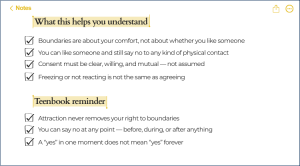
Boundaries are not about whether you like someone. They are about what you are comfortable with and they exist even when you have feelings for someone.
Liking someone does not give them permission to touch you. And freezing, or not reacting, does not mean you agreed to something.
RHEA’S STORY

Rhea, 15
“During a group hangout, someone leaned into me without asking. I froze. Later I kept wondering, did I give the wrong impression? Had I said something that made them think that was okay?”
Rhea had not done anything wrong. The person had crossed a boundary without asking. Boundaries belong to you, they do not disappear because of how someone else interprets your behaviour.
When you have questions, ask someone you trust
It is completely okay to have questions about any of this. About attraction, about the body, about sex, about what to do when something confusing or uncomfortable happens. Questions are how we learn.
The important thing is to bring those questions to someone who actually knows the answers and who you can trust, not just whoever happens to be nearby, and not just what you find from a random search or a pop-up.

Who are trusted adults?
A Trusted Adult is someone older than you who is knowledgeable, honest, and has your best interests at heart. This might be a parent or guardian, an older sibling or cousin, a grandparent, a teacher, or a school counsellor.
Not everyone you know has the right answers. That is not a failure on their part, it just means they are also learning. If one Trusted Adult does not know, they can help you find someone who does.
It is okay if you cannot identify a Trusted Adult right away. Take your time. The right person is out there.
Remember
Honest questions about attraction and sex are normal and healthy. Bring questions to a Trusted Adult, someone who knows and cares. If something uncomfortable happens online or offline, tell a Trusted Adult


I am glad that there’s a very useful website like yours. It explains everything that teens need to know in simple words. Most of the families dont have a open talk on these things. And it’s mostly hard for the teens to talk such matters. So Very nice. Hats off to your work.