
header image

Teen Guide
Staying safe

Staying safe: Keep this in mind

The “Vibe Check” 

Ishaan: “I was coming back from Physics coaching. It was getting dark, and I took a shortcut I usually avoid. A guy on a parked scooty called out, ‘Oye, can you help me with a map location?’ He looked normal, but something about how he was positioned, blocking the narrow path,made my heart race. My brain said ‘be helpful,’ but my legs said ‘run.’ I didn’t look back; I ran to the main road where the momos stall is crowded and called my brother. My friends later told me that guy has been hanging around several coaching centers lately.”
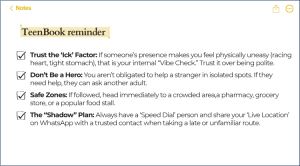
  • Trust the ‘Ick’ Factor: If someone’s presence makes you feel physically uneasy (racing heart, tight stomach), that is your internal “Vibe Check.” Trust it over being polite.
  • Don’t Be a Hero: You aren’t obligated to help a stranger in isolated spots. If they need help, they can ask another adult.
  • Safe Zones: If followed, head immediately to a crowded area,a pharmacy, grocery store, or a popular food stall.
  • The “Shadow” Plan: Always have a ‘Speed Dial’ person and share your ‘Live Location’ on WhatsApp with a trusted contact when taking a late or unfamiliar route.

The “Cool Senior” Trap 

Meher: “I used to love basketball trials, but now I make excuses to skip. There’s this senior, Kabir,everyone thinks he’s the ‘cool’ captain. He started ‘mentoring’ me, but he’d stand way too close. The other day, he ‘accidentally’ grabbed my waist to ‘correct my form’ and didn’t let go. I felt paralyzed because he’s popular and I didn’t want to make a scene. Now, I spend the whole session just trying to stay on the opposite side of the court.”
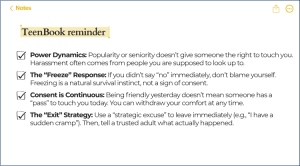
  • Power Dynamics: Popularity or seniority doesn’t give someone the right to touch you. Harassment often comes from people you are supposed to look up to.
  • The “Freeze” Response: If you didn’t say “no” immediately, don’t blame yourself. Freezing is a natural survival instinct, not a sign of consent.
  • Consent is Continuous: Being friendly yesterday doesn’t mean someone has a “pass” to touch you today. You can withdraw your comfort at any time.
  • The “Exit” Strategy: Use a “strategic excuse” to leave immediately (e.g., “I have a sudden cramp”). Then, tell a trusted adult what actually happened.

The “Snap” Scam (Online Safety & Cyberbullying)

Zoya: “I met Neo_99 on a Discord server for a mobile game. He seemed chill and helped me level up. We moved to Snapchat, and he sent photos of his setup. Then he started asking for a ‘face reveal’ or a selfie in my school uniform to see if we go to the same coaching. When I hesitated, he got pushy, saying ‘don’t be a prude, it disappears anyway.’ I’m starting to wonder if he’s even a student.”
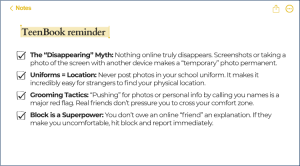
  • The “Disappearing” Myth: Nothing online truly disappears. Screenshots or taking a photo of the screen with another device makes a “temporary” photo permanent.
  • Uniforms = Location: Never post photos in your school uniform. It makes it incredibly easy for strangers to find your physical location.
  • Grooming Tactics: “Pushing” for photos or personal info by calling you names is a major red flag. Real friends don’t pressure you to cross your comfort zone.
  • Block is a Superpower: You don’t owe an online “friend” an explanation. If they make you uncomfortable, hit block and report immediately.

The “Vape” Culture 

Aryan: “At a post-exam party, some guys passed around a ‘vape.’ My best friend, Vihaan, took a hit and said, ‘Bro, it’s just flavored steam, it’s not even like real smoking.’ I felt like a loser with my soft drink. I play football and was worried about my lungs, but I was more worried about everyone thinking I was a ‘teacher’s pet.'”
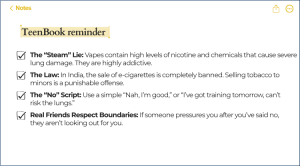
  • The “Steam” Lie: Vapes contain high levels of nicotine and chemicals that cause severe lung damage. They are highly addictive.
  • The Law: In India, the sale of e-cigarettes is completely banned. Selling tobacco to minors is a punishable offense.
  • The “No” Script: Use a simple “Nah, I’m good,” or “I’ve got training tomorrow, can’t risk the lungs.”
  • Real Friends Respect Boundaries: If someone pressures you after you’ve said no, they aren’t looking out for you.

Beyond the “World AIDS Day” Poster 

Saira: “I saw the posters at school, but the comments on a viral reel about STIs were way more confusing. People were making jokes, but some were scared. I realized I didn’t actually know how HIV or Hep-B spread. Is it just ‘adult stuff,’ or can you get it from the local tattoo shop or sharing a gym towel? I wanted to ask, but didn’t want my parents to think I was ‘up to something.'”
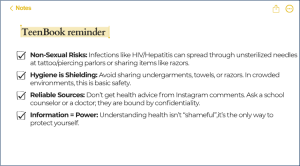
  • Non-Sexual Risks: Infections like HIV/Hepatitis can spread through unsterilized needles at tattoo/piercing parlors or sharing items like razors.
  • Hygiene is Shielding: Avoid sharing undergarments, towels, or razors. In crowded environments, this is basic safety.
  • Reliable Sources: Don’t get health advice from Instagram comments. Ask a school counselor or a doctor; they are bound by confidentiality.
  • Information = Power: Understanding health isn’t “shameful”,it’s the only way to protect yourself.

The “Old School” Newbie (Bullying & Regional Bias)

Tashi: “Moving from the hills to a big city school was a nightmare. Because I have an accent, a group of girls started a ‘meme’ page about me. They call me names in the canteen and ‘accidentally’ spill water on my projects. They think it’s ‘dark humor,’ but I feel hunted. Even the ‘chill’ kids just watch and laugh, which hurts more than the bullying.”
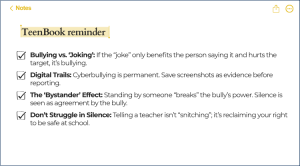
  • Bullying vs. ‘Joking’: If the “joke” only benefits the person saying it and hurts the target, it’s bullying.
  • Digital Trails: Cyberbullying is permanent. Save screenshots as evidence before reporting.
  • The ‘Bystander’ Effect: Standing by someone “breaks” the bully’s power. Silence is seen as agreement by the bully.
  • Don’t Struggle in Silence: Telling a teacher isn’t “snitching”; it’s reclaiming your right to be safe at school.

The “Voice Clone” Scam

Karan: “I got a frantic call from my best friend, Aryan. It sounded exactly like him,his voice, even his stutter. He said he was at a police checkpoint for a scooty accident and needed ₹5,000 for a ‘fine.’ I was about to open UPI, but I remembered he was in a ‘No Phones’ coaching class. I hung up and called his mom. He was safe in class. Someone had used a clip from his Instagram Reels to clone his voice.”
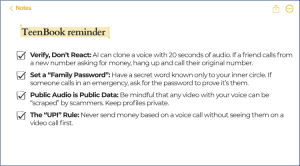
  • Verify, Don’t React: AI can clone a voice with 20 seconds of audio. If a friend calls from a new number asking for money, hang up and call their original number.
  • Set a “Family Password”: Have a secret word known only to your inner circle. If someone calls in an emergency, ask for the password to prove it’s them.
  • Public Audio is Public Data: Be mindful that any video with your voice can be “scraped” by scammers. Keep profiles private.
  • The “UPI” Rule: Never send money based on a voice call without seeing them on a video call first.

The “Safe Circle”

Ishaan: “I used to think I could handle everything. But after the ‘scooty’ incident and the party pressure, I was a mess. I finally talked to my older cousin. He didn’t lecture me; he just told me he’d been through it too. Having one person who ‘gets it’ made the anxiety go away.”

Tashi: “It took courage, but I showed the counselor the meme page. The school took it seriously, and the ‘cool girls’ had to apologize. I’ve joined the Art Club now. It’s a ‘Safe Circle’ where nobody cares about my accent.”
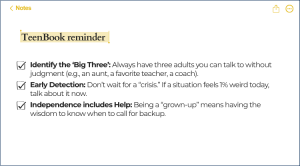
  • Identify the ‘Big Three’: Always have three adults you can talk to without judgment (e.g., an aunt, a favorite teacher, a coach).
  • Early Detection: Don’t wait for a “crisis.” If a situation feels 1% weird today, talk about it now.
  • Independence includes Help: Being a “grown-up” means having the wisdom to know when to call for backup.

Leave a comment

Your email address will not be published. Required fields are marked *