
Menstruation: A handy guide to periods
It started during the girls’ weekly WhatsApp call.
Everyone was mid-laughter about a teacher’s ringtone when Sara suddenly went quiet.
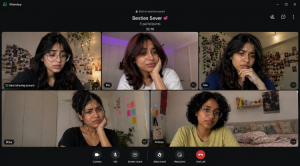
Pia noticed immediately. “Why are you quiet? Network gaya ya mood gaya?”
Sara hesitated. “I think…I got my period today.”
Silence.
“I saw blood in the morning,” she rushed. “I didn’t know what to do. I Googled it and now I’m more confused.”
Pia nodded. “Yeah, Google during a panic? Bold move.”
Sara gave a weak smile. “So I’m fine?”
“You’re fine,” Pia said. “Just slightly upgraded.”
Pia’s story: “Wait…is this normal?”
“My first time, I thought something was wrong,” Pia said.
“I had cramps, I was irritated for no reason, and I cried because someone ate my chocolate.”
Sara blinked. “That’s…a lot.”
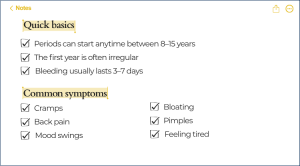
“It’s confusing, not dangerous,” Pia said. “And the first few months? Total chaos. Early, late, heavy, light—everything.”
Sara leaned in. “So irregular is okay?”
“Completely.”
Mia’s story: “Okay but WHY is this happening?”
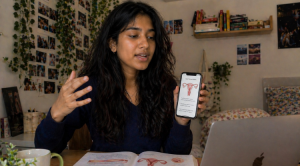
“I couldn’t relax till I understood the logic,” Mia said.
“So I asked my mom, my teacher, and yes…watched a very questionable biology video.”
Sara laughed. “And?”
“It’s not random. Your body has a system.”
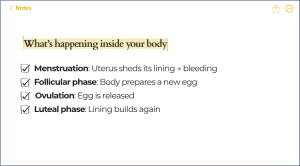
Sara frowned. “Why build it just to remove it?”
“Because your body is preparing for a possible pregnancy every month,” Mia said.
“It releases an egg and builds a soft lining.”
Sara hesitated. “Wait…so this has something to do with babies?”
Mia nodded. “Yeah. If the egg meets a sperm, it can turn into a pregnancy. That’s how a baby starts developing.”
“And if nothing happens?” Sara asked.
“Then your body clears it out. That’s your period.”
“So…monthly reset?”
“Exactly.”
Sara made a face. “Okay that’s a lot to process.”
“Relax,” Mia said quickly. “Just because your body can do this someday doesn’t mean it’s ready now. That takes years, physically and mentally.”
“Good,” Sara said. “Because I’m still figuring out maths.”
Pia’s answer to: “What product do I use?”
Sara sighed. “Okay, next problem. My mom only told me about pads, but there’s so much more out there now, right?”
Pia grinned. “Welcome to the periods buffet. Wait that sounded better in my head.”
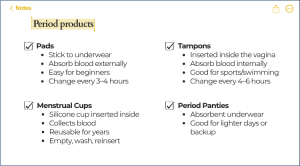
Sara asked, “So what should I start with?”
“Pads,” Meera said. “Simple, no stress. You can experiment later. This isn’t a lifelong commitment.”
“And please don’t ignore the basics,” Meera added.
Hygiene + care
- Change products regularly (don’t wait too long)
- Wash hands before and after
- Wrap used pads/tampons and throw in a dustbin
- Don’t flush them (seriously)
- Stay clean, hydrated, and eat well
Rhea’s story: “My dadi had…opinions”
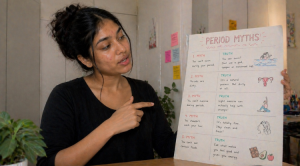
“My dadi gave me a full rulebook,” Rhea said dramatically.
“No kitchen, no pickles, no existing happily.”
Everyone laughed.
“I ignored most of it,” she added. “Nothing happened.”
Myths vs reality
Myths
- You can’t touch pickles
- You shouldn’t shower
- You’re “impure”
- You can’t exercise
Reality
- None of this is true
- Periods are normal
- You can go to school, play, live your life
“What does help,” Rhea said, “is not pretending you’re fine when you’re not.”
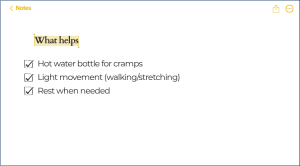
“And chocolate,” Pia added.
“Obviously,” Meera said.
Ananya’ s tip: Track your cycle
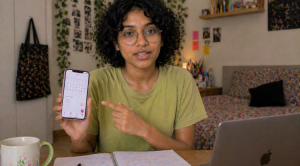
“And don’t let it surprise you, track your cycle,” Ananya said. “Future you will thank you.”
Sara groaned. “Do I need to do math?”
“Barely,” Ananya said. “And honestly, there are so many apps now. You just tap a date and it does the rest. Zero effort, full marks.”
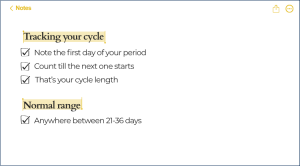
“Everyone’s cycle is different,” Pia added. “No comparing.”
Sara frowned. “What if it doesn’t come on time? Like…what if it’s late?”
Pia shook her head. “That happens all the time, especially in the beginning. Your body is still figuring out its rhythm.”
Meera added, “If your period is early, late, or skips sometimes in the first year or two, it’s usually normal. It doesn’t mean something is wrong.”
Sara exhaled. “Okay…that makes me feel better.”
Ananya added, “And just so you know, periods don’t last forever. They usually stop in your late 40s or 50s. That stage is called menopause.”
Rhea blinked. “So this is a limited-time situation?”
“Long-term limited,” Pia said. “Very long-term.”
The group wrap-up
“And hey,” Pia said, “if you’re ever confused, talk to your mom, a teacher, or any adult you trust.”
“Yeah,” Meera added. “Google can make things worse sometimes.”
Sara finally smiled.
What started as panic now felt…manageable.
“Okay,” she said. “I think I’ve got this.”
“Of course you do,” Pia said. “Welcome to the club.”
“Worst club ever,” Rhea muttered.
“Speak for yourself,” Meera said. “Great character development.”
And just like that, they were back to laughing.
Want more real talk on this? Check out our podcast episode on dealing with periods
Thanks for this information I am so glad to know this 😊
Tq so much I also have some problems u gave me some information