
header image

Teen Guide
Stress busters

Stress: Here’s how to deal with it

Whether it is the soul-crushing pressure of board exams, parents who seem to be speaking a different language, or friends who act like judges on a reality show, stress is everywhere. Aarav, Sara, and their friends are going through it right now. Let’s look at what is actually happening.

Chapter 1: The midnight grind

Aarav has been staring at the same paragraph of his Economics textbook for forty minutes. It is 2:00 AM. His desk is a graveyard of empty coffee mugs and crumpled snack wrappers. He can hear his dad’s voice in his head, already rehearsing the “I am disappointed” speech if Aarav doesn’t land that scholarship. His heart is thumping like a bass drum, and he is pretty sure he has forgotten how to breathe normally.
The Science 

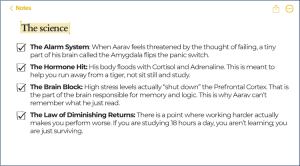
  • The Alarm System: When Aarav feels threatened by the thought of failing, a tiny part of his brain called the Amygdala flips the panic switch.
  • The Hormone Hit: His body floods with Cortisol and Adrenaline. This is meant to help you run away from a tiger, not sit still and study.
  • The Brain Block: High stress levels actually “shut down” the Prefrontal Cortex. That is the part of the brain responsible for memory and logic. This is why Aarav can’t remember what he just read.
  • The Law of Diminishing Returns: There is a point where working harder actually makes you perform worse. If you are studying 18 hours a day, you aren’t learning; you are just surviving.

Chapter 2: The social shadow

Sara is hiding in the school bathroom. She just saw a notification that Aditi posted a photo from the weekend. Everyone is in it except her. To make things worse, someone commented on Sara’s last post saying her new glasses make her look like a “disturbed owl.” Now, she is convinced everyone in the hallway is laughing at her. She feels sick to her stomach and just wants to disappear.
The science of social stress

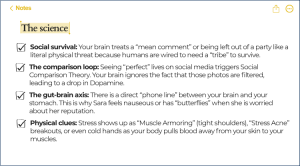
  • Social survival: Your brain treats a “mean comment” or being left out of a party like a literal physical threat because humans are wired to need a “tribe” to survive.
  • The comparison loop: Seeing “perfect” lives on social media triggers Social Comparison Theory. Your brain ignores the fact that those photos are filtered, leading to a drop in Dopamine.
  • The gut-brain axis: There is a direct “phone line” between your brain and your stomach. This is why Sara feels nauseous or has “butterflies” when she is worried about her reputation.
  • Physical clues: Stress shows up as “Muscle Armoring” (tight shoulders), “Stress Acne” breakouts, or even cold hands as your body pulls blood away from your skin to your muscles.

Chapter 3: The “too much” plate

Aarav’s phone is buzzing. It is his friend Aryan, who is pushing him to try a cigarette to “chill out.” Meanwhile, his mom is shouting about him not helping with his sister. On top of that, he is “on read” by his crush, and he has a football trial tomorrow. He feels like a computer that has too many tabs open and is about to crash.
The Science 

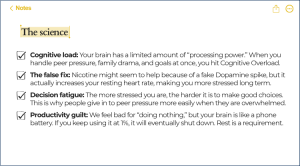
  • Cognitive load: Your brain has a limited amount of “processing power.” When you handle peer pressure, family drama, and goals at once, you hit Cognitive Overload.
  • The false fix: Nicotine might seem to help because of a fake Dopamine spike, but it actually increases your resting heart rate, making you more stressed long term.
  • Decision fatigue: The more stressed you are, the harder it is to make good choices. This is why people give in to peer pressure more easily when they are overwhelmed.
  • Productivity guilt: We feel bad for “doing nothing,” but your brain is like a phone battery. If you keep using it at 1%, it will eventually shut down. Rest is a requirement.

Chapter 4: Zero battery

Sara used to love the school play. But lately, even the thought of rehearsal makes her feel like she is moving through wet cement. Her favorite playlist sounds annoying, her head has a dull ache that won’t go away, and she just snapped at her brother for no reason. She isn’t just tired; she feels like her “internal battery” is broken and won’t hold a charge anymore.
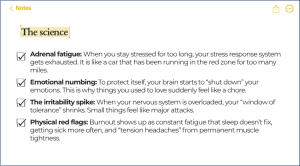
The science of burnout

  • Adrenal fatigue: When you stay stressed for too long, your stress response system gets exhausted. It is like a car that has been running in the red zone for too many miles.
  • Emotional numbing: To protect itself, your brain starts to “shut down” your emotions. This is why things you used to love suddenly feel like a chore.
  • The irritability spike: When your nervous system is overloaded, your “window of tolerance” shrinks. Small things feel like major attacks.
  • Physical red flags: Burnout shows up as constant fatigue that sleep doesn’t fix, getting sick more often, and “tension headaches” from permanent muscle tightness.

Chapter 5: The recovery phase

Aarav finally decides to close the book. He takes ten deep breaths and puts his phone on “Do Not Disturb.” He realizes his worth isn’t tied to one exam. He decides to talk to his older cousin who always keeps it real. Slowly, the “heavy” feeling starts to lift.
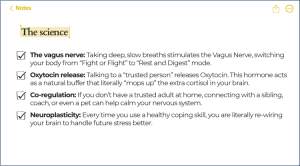
The science of calming down

  • The vagus nerve: Taking deep, slow breaths stimulates the Vagus Nerve, switching your body from “Fight or Flight” to “Rest and Digest” mode.
  • Oxytocin release: Talking to a “trusted person” releases Oxytocin. This hormone acts as a natural buffer that literally “mops up” the extra cortisol in your brain.
  • Co-regulation: If you don’t have a trusted adult at home, connecting with a sibling, coach, or even a pet can help calm your nervous system.
  • Neuroplasticity: Every time you use a healthy coping skill, you are literally re-wiring your brain to handle future stress better.

Your stress survival toolkit

1. The stress mapping exercise

Stress likes to hide in your body. Take a moment to scan yourself from head to toe.

  • The jaw clench: If your teeth are touching, drop your jaw and relax your tongue.
  • The shoulder shrug: Drop your shoulders away from your ears to release your “armor.”
  • The pit in the stomach: Recognize that nausea is just your body saving energy for a “fight.”
  • Cold hands: This is just blood moving to your heart to help you “survive.”

2. The 5-4-3-2-1 grounding technique

When the world feels like it is spinning too fast, use your five senses to pull your brain back to the “right now.”

  • 5 things you can see: A crack in the wall, a specific color.
  • 4 things you can touch: Your shirt, a cold desk, your hair.
  • 3 things you can hear: The AC hum, a bird, your breathing.
  • 2 things you can smell: Laundry detergent, pencil lead.
  • 1 thing you can taste: Toothpaste or just the inside of your mouth.

3. Peer pressure hacks

  • The Ghost: Just walk away. You don’t owe anyone an explanation.
  • The Hard No: “Nah, I’m good” works better than a long excuse.
  • The Pivot: “I’m not into that, let’s just go get a burger instead.”

Don’t forget to check out TeenBook’s podcast on How to deal with stress.
Leave a comment

Your email address will not be published. Required fields are marked *