
Growing up: All you need to know
Aarav · Ranchi · Grade 8
“Over the last few weeks, I have been noticing tiny hair on my chin. Papa tells me this is the first sign of Growing Up — when children begin to develop into adults. I am quite nervous but at the same time a bit excited about this!”

Sara · Surat · Grade 8
“Ammi also tells me now that I am growing up, I will have to start making my own choices. Oh, that’s going to be exciting — but also a lot to figure out.”
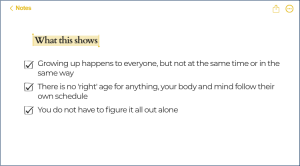
Growing up is an adventure — sometimes exciting, sometimes confusing, sometimes both at once. Changes are happening in your body, your mind, and your relationships with the people around you. If things feel strange or uncertain right now, you are not alone. Every single teen goes through this.
And the most important thing to know? There is no single right way to do it.
What Is Actually Changing?
THE FOUR TYPES OF CHANGE
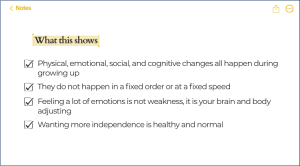
When we talk about growing up, we usually mean changes happening across four areas of life — sometimes all at once, which is why it can feel like a lot.
Physical changes

Your body is growing and developing. This might include growing taller, body hair appearing, skin changes like pimples, a deeper voice, or changes in body shape. These changes are part of puberty — and we cover them in more detail in the companion resource, Puberty and Body Changes.
Emotional changes
“These days I worry a lot. Some days I stress about failing exams. Then about the pimples all over my face. Then about Sports Day, and the debating competition. It feels like there’s just a lot going on. Honestly.” – Tenzin

Your feelings become stronger and more varied. Excitement, sadness, anger, embarrassment, loneliness, pride — all can show up more intensely than they used to. Having crushes on someone is also completely normal at this age. So is feeling like your emotions are all over the place.
Social changes
“I had a big fight with Mummy today. She asked me to spend less time with my friends and focus on my studies. I do focus on my studies — but I like being with my friends. Why can’t she understand that?” – Mira

You may find yourself wanting more independence, more time with friends, and more say in decisions about your own life. Relationships with family can sometimes feel more complicated. Friendships become a bigger part of your world. This is all completely normal — it is how teenagers grow into adults.
Cognitive changes (how you think)

Your brain is developing too. You start to think more deeply, question things that you previously accepted, form your own opinions, and make more complex decisions. You might find yourself caring more about fairness, meaning, or what kind of person you want to be.
A Word About Your Body
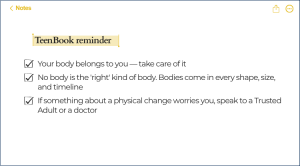
Physical changes during growing up are part of a process called puberty. Your body is preparing for adulthood — and while some changes can feel sudden or strange, all of them are natural.
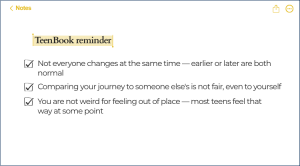
Everyone’s physical journey is different. Some start earlier, some later. Some notice physical changes before emotional ones. All of it is normal.
Supporting your body through change
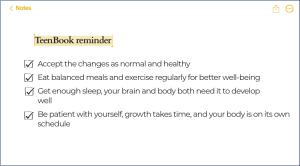
Your body is doing a lot of work. Here is how you can support it:
For a fuller picture of what puberty involves — including what happens in girls, boys, and transgender teens, and why — see the companion resource: Puberty and Body Changes.
Making Choices — And Making Them Well
“Yesterday I got my first pocket money and I am so confused. I want to buy a book on art and craft — but I also need new shoes. How do I decide?” – Maria

“After sports class, Rishi pulled a cigarette out of his bag. He said to try it. I couldn’t say no. Today everyone wants to do it again, as a group. Rishi is my best friend. I don’t want to get him in trouble. But I am not sure what to do.” – Amit
Growing up means making more choices for yourself. Some are small — what to do with pocket money. Some are much bigger — how to handle pressure from friends, or whether to go along with something that feels wrong.
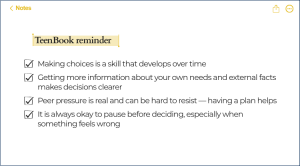
Making good choices is a skill. And like any skill, it gets better with practice and information.
Step one: Get more information
One of the most important steps in making any choice is finding out more. Some of that information is internal — understanding your own needs, values, and feelings. Some is external — facts from books, trusted people, or reliable sources online.
Maria’s pocket money dilemma is a good example. Once she finds out the prices of both items, she might realise she can afford both. Or she might find out her cousin has the book and can lend it. Having more information changes what the choice even is.
Step two: Use the Seven Step Ladder
When a choice is genuinely hard — especially when there is peer pressure involved, or when you are not sure if something is safe — work through the Seven Step Ladder. Start from the bottom and go up.
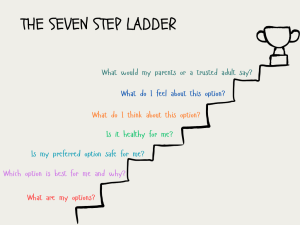
For Amit, the cigarette situation: his options are to go along, to say no, or to talk to someone he trusts. Walking through the ladder — is it safe? Is it healthy? Would he suggest it to a friend? What would his parents say? — makes the right direction clearer, even if saying no still feels hard.
Step three: Talk to someone
Some choices are too big or too complicated to work through alone. That is not a weakness — it is wisdom. Identifying someone you can go to for honest advice, without fear of being judged, is one of the most useful things you can do during these years.
Trusted Adults: Your Go-To People
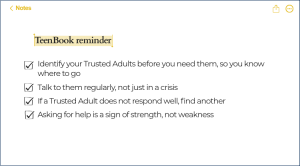
A Trusted Adult is a grown-up you can go to with anything — questions, worries, decisions that feel too big, or situations that feel wrong — and know they will listen without judging, and actually help.
Who counts as a Trusted Adult?
This could be a parent or guardian, an older sibling or cousin, a grandparent, a teacher, or a school counsellor. The key is that they are someone who knows you, cares about you, has good information, and makes you feel safe enough to be honest.
Not every adult in your life will be the right fit. That is okay. If someone dismisses you, or makes you feel embarrassed for asking, find another person. You deserve someone who actually listens.
When should you go to a Trusted Adult?
When a decision feels too hard to make alone. When something is happening — at school, online, at home — that feels wrong or confusing. When you have questions about your body, your feelings, or your identity that you cannot find good answers to. When peer pressure is making it hard to stick to what you believe is right.
You do not need to have everything figured out before you go to them. “Something is happening and I am not sure what to do” is enough to start the conversation.
The Bottom Line
Growing up is a process
It involves change in your body, your emotions, your social world, and how you think. None of these happen on a fixed schedule, and none of them happen the same way for any two people.
You are not alone in this
Every teen — across every generation — has gone through a version of this same journey. Feeling confused, overwhelmed, or out of place is completely normal. It does not mean something is wrong with you.
You can make good choices
With information, with the Seven Step Ladder, and with the support of people you trust, you can navigate even the hard moments.
Find your people
Identify your Trusted Adults. Talk to them. Ask questions. You do not have to figure out growing up alone — and you will handle it better when you do not try to.
Thankyou
Heyyy
Hiiiiii
My name is saroja I like dance
My name is Pari i like dance my favourite hobby dance
Mujhe dance or drowning pasand hai
I am Ayesha i like study
I love only study and some time I play
I love study
Thank you