

Reproduction: How are babies born?
“Didi, what is sex? I know Mumma and Papa will freak out if I use that word, but I want to know how Ishi actually happened.”

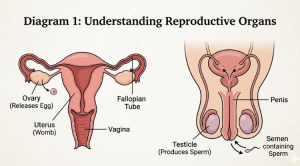
“I’m glad you asked me. It’s just biology, and it’s better to have the facts. During puberty, our bodies develop reproductive organs. In females, these are the ovaries and the uterus. In males, these are the testicles.”
Understanding the body parts:
The penis is a male organ used to pass urine and also to release semen.
The vagina is a passage inside the body that connects to the uterus. The uterus is where a baby can grow.
In females, once a month, an ovary releases a reproductive cell called an egg or ovum.
In males, the testicles produce sperm, which are tiny cells carried in a fluid called semen.
“So, how do those two cells actually get together?”
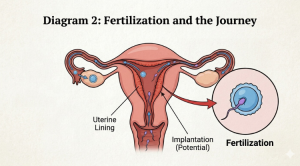
“That happens through sexual intercourse, or sex. It’s when a man’s penis goes inside a woman’s vagina. If they want to have a baby, the male releases semen inside the vagina, and the sperm swim up toward the uterus and then into the fallopian tube to find the egg.”
Fertilization: When a sperm meets and joins with an egg, usually in the fallopian tube, it is called fertilization.
Implantation: After fertilization, the fertilized egg travels to the uterus and attaches to its lining. This step is called implantation.
Timing: Since an egg is only released once a month, sex doesn’t always result in a pregnancy.
“But what if there is no sex, or the egg doesn’t find any sperm? What happens to the egg then?”
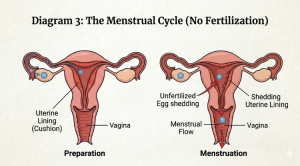
“That’s exactly how periods happen. Every month, the uterus builds up a ‘cushion’ of blood and tissue to prepare for a possible baby. If there is no meeting of the egg and sperm, the body doesn’t need that cushion.”
The Cycle: The unfertilized egg and the thickened uterine lining leave the body through the vagina.
Menstruation: This monthly process is called a period.
“And if they do meet? How does a baby actually get out?”
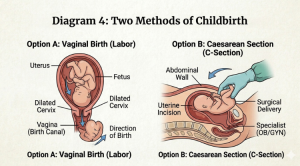
“If they meet, they form a fetus that grows in the uterus for nine months. When the baby is ready, it comes out through the vagina in a process called labor.”
C-Section: Sometimes, doctors (specialists in obstetrics and gynecology) perform a Caesarean operation, making a small cut in the abdomen to deliver the baby safely.
“So every baby in the world starts with sex then?”
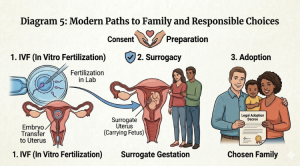
“Actually, no. There are many ways to make a family today.”
IVF: Doctors help the sperm and egg meet in a lab before placing them in the uterus.
Surrogacy: Another person carries and gives birth to the baby for the parents.
Adoption: Parents legally welcome a child born to someone else into their family and raise them as their own.
“It sounds like a lot can happen. How do people stay safe?”
“Two things are vital: Consent and Protection. Consent means a clear, enthusiastic ‘YES’ from everyone involved. It’s not just the absence of a ‘no’. People should be physically and mentally ready first. In India, the legal age for sex or marriage is 18 for women and 21 for men.”
“And if people choose to have sex but do not want a pregnancy or a baby, protection becomes really important.”
What are the common options?
Condoms
“These are worn on the penis. They help stop sperm from entering the vagina.”
“They are the only method that also helps protect against infections, called STIs.”
Birth control pills
“These are taken regularly by a person with ovaries and help prevent pregnancy by controlling hormones.”
“They do not protect against infections.”
Emergency contraception
“This is used after unprotected sex to reduce the chance of pregnancy. It is not meant to be used regularly.”
“Without protection, sex can lead to an unplanned pregnancy or infections. And that can bring stress, health risks, and situations people may not be ready to handle. Using protection is about being responsible for your body and your future.”
“Thanks, Didi. I feel much better knowing the science behind it all.”
“Anytime! Your health and safety always come first. If you ever have more questions, just ask.”